Finance
Salary to Hourly Calculator
Convert an annual salary into what you actually earn per hour, week, and month. Adjust the hours you really work and the weeks you're paid for to get an honest hourly rate.
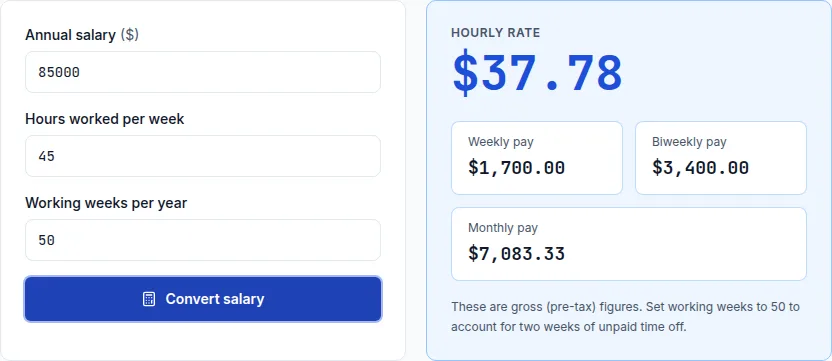
Hourly rate
$31.25
Weekly pay
$1,250.00
Biweekly pay
$2,500.00
Monthly pay
$5,416.67
These are gross (pre-tax) figures. Set working weeks to 50 to account for two weeks of unpaid time off.
How it works
The conversion is straightforward: your annual salary divided by the total hours you work in a year. Total hours are your weekly hours multiplied by the number of working weeks.
The standard assumption in the US is 40 hours a week for 52 weeks — 2,080 hours a year. That makes mental math easy: every $10,000 of salary is roughly $4.80 an hour.
The honest version of this number depends on your real schedule. If you routinely work 50-hour weeks, your true hourly rate is 20% lower than the standard calculation suggests. Set the inputs to match reality.
Hourly rate = Annual salary / (hours per week × weeks per year)

Example: $65,000 / (40 × 52) = $65,000 / 2,080 = $31.25/hour
When you'd use this
- Comparing a salaried job offer against an hourly position with overtime.
- Setting a freelance hourly rate based on a target annual income.
- Figuring out your real hourly rate after accounting for unpaid overtime.
Frequently asked questions
How do I convert my salary to an hourly rate?
Divide your annual salary by the number of hours you work per year. For a standard 40-hour week across 52 weeks, that's 2,080 hours — so a $65,000 salary is $31.25 per hour.
What is $50,000 a year per hour?
At 40 hours a week for 52 weeks, $50,000 a year works out to about $24.04 per hour, $961.54 per week, or $4,166.67 per month before taxes.
Should I use 50 or 52 weeks in the calculation?
Use 52 if you're salaried with paid vacation, since you're paid for every week of the year. Use 50 (or fewer) if you're hourly or freelance and don't get paid for time off — it gives a more realistic effective rate.
Are these amounts before or after tax?
Everything here is gross pay — before income tax, Social Security, Medicare, retirement contributions, and insurance premiums. Take-home pay is typically 70–80% of gross, depending on your tax situation and benefits.
Does overtime change my effective hourly rate?
If you're salaried and exempt from overtime, extra hours lower your effective hourly rate because the salary is fixed. Enter your true average weekly hours to see what you're actually earning per hour worked.
From the blog
Related tools